
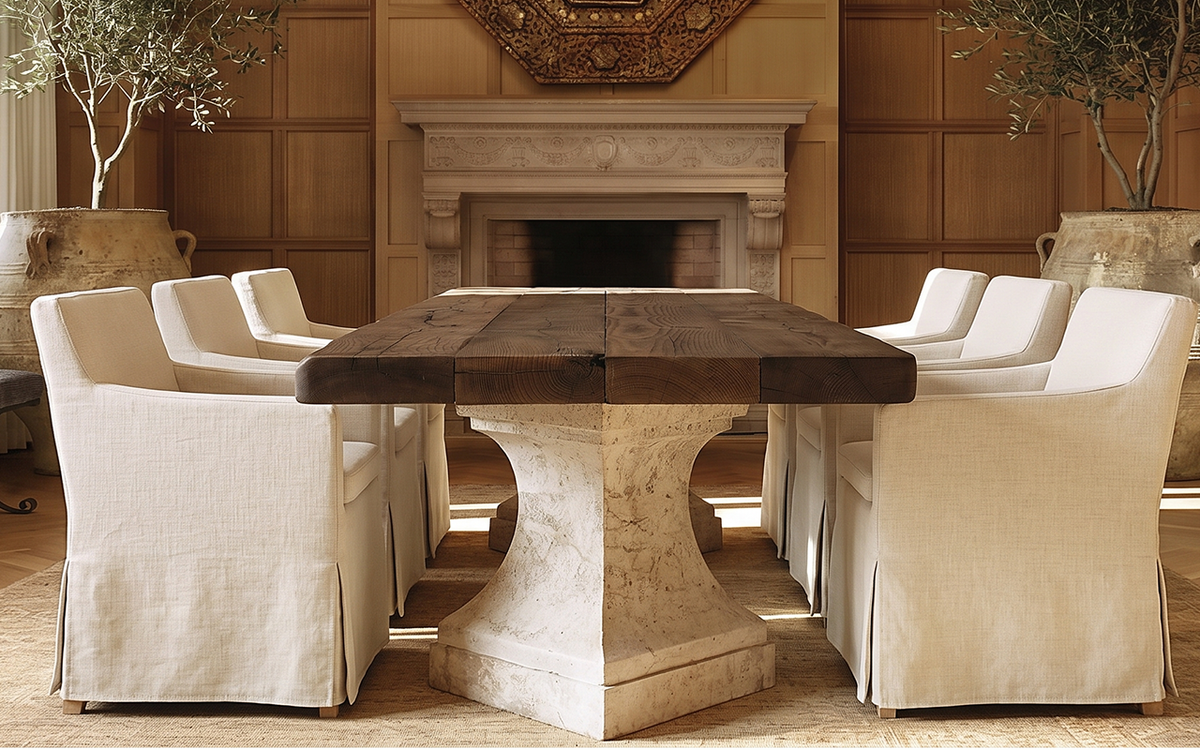
Agora Solid Oak & Carved Stone Long Dining Table

WS Living · Signature piece
AGORA
Solid oak, carried on carved stone. A long table made for gathering.
Some furniture fills a room. Agora gives it a centre.

IThe history
Named for the gathering place
In ancient Athens, the agora was the open heart of the city: the square where people met to trade, to debate, to share bread and news. Nothing important happened alone. It happened around a common surface.
The long table carries that idea forward. In the refectories of medieval monasteries and the great halls of European estates, one long board was where a whole household came together. The baluster, born in the carved stone balustrades of Renaissance Italy, gave those halls their rhythm: a column that swells and narrows like a held breath.
Agora brings both lineages into a Dubai dining room: the honest plank of the refectory, and the sculpted stone of the classical hall.
- c. 500 BC · AthensThe agora: the open square where a city gathered.
- Middle Ages · EuropeThe refectory table: one long board, one household.
- 15th century · ItalyThe baluster: the carved stone profile of the Renaissance.
- Today · DubaiAgora: the old forms, made for how we gather now.
IIThe engineering
Monumental to look at. Practical to live with.
A table that looks carved from a quarry still has to travel up a lift and stand on a villa floor. Agora is the result of solving both.
 12345
-
01
The plank top
Wide solid oak planks in a deep dark walnut stain. Knots, grain lines and end-grain rings are kept, not filled: the record of the tree is the finish.
-
02
The edge
A deliberately thick, square-cut edge gives the top its weight and presence from every side of the room.
-
03
The pedestal
Two sculpted baluster pedestals, cast in a proprietary composite that recreates the pitted, weathered surface of hand-carved limestone.
-
04
The plinth
A stepped square plinth grounds each pedestal and spreads the load evenly across the floor.
-
05
The span
Two pedestals instead of four legs: the corners stay free, so eight guests sit comfortably without a table leg in the way.
Stone presence, without stone weight
The composite gives the look and touch of aged limestone at a fraction of the weight of quarried stone, so delivery and placement stay practical.
Hand-finished, piece by piece
Each pedestal is finished by hand for its aged character, and each plank is chosen for the depth of its grain.
Built around the guest
Long enough for eight, with the pedestals set to keep knee room and corners open.

IIIOne of a kind
Singular, by nature
No two Agora tables are the same. The oak decides where its knots fall and how its grain runs. The hand that finishes each pedestal decides where the stone is pitted and where it is worn smooth.
The table you receive shares this design and carries its own character. That is not a variation to tolerate. It is the point.
Made to be gathered around for generations.


